Posted: 2025-12-22
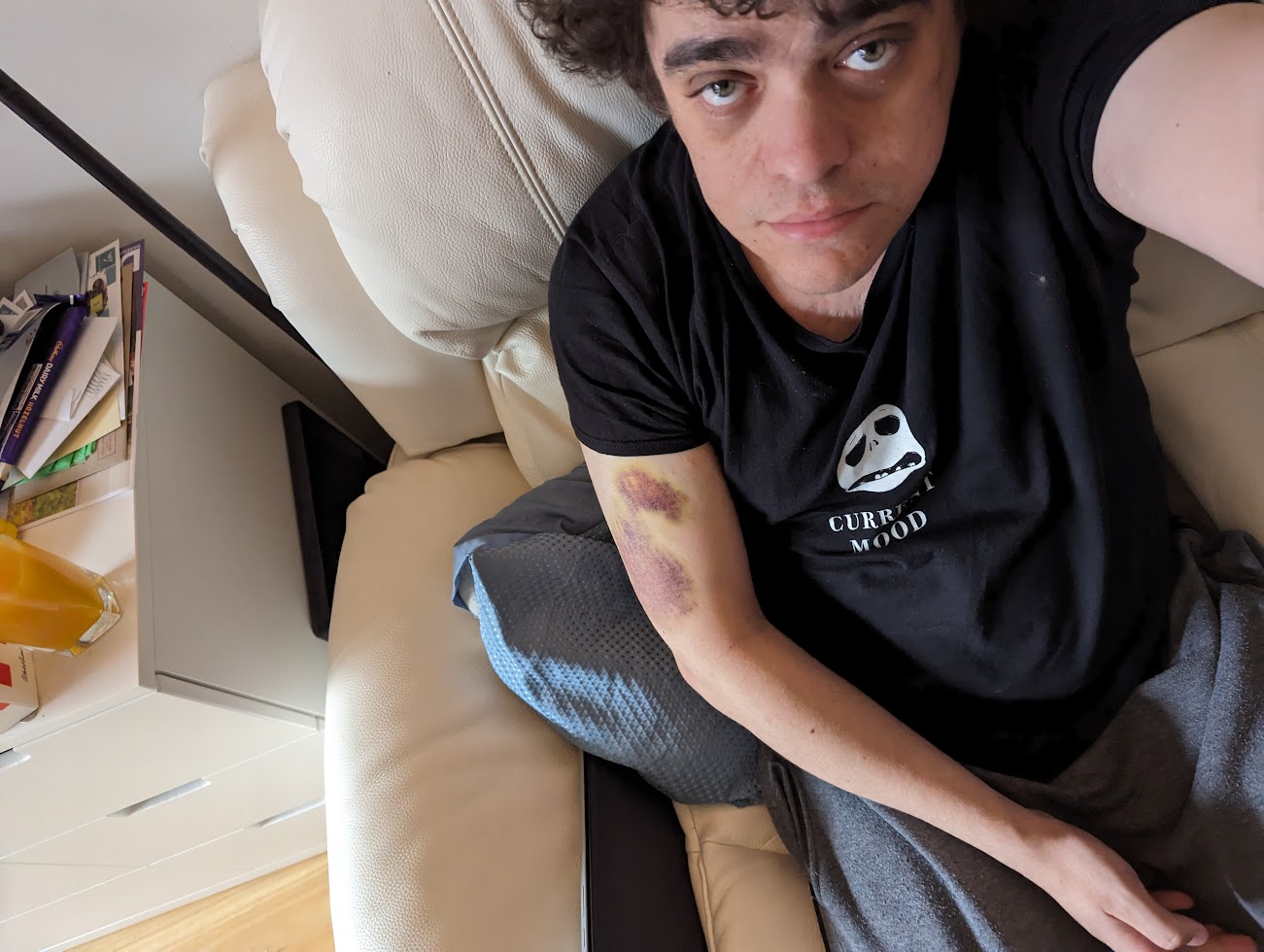
Inset: me sheltering via couch-surfing after escaping. I noticed the bruise afterwards, so I can't 100% say for sure it was from when I was pushed and fell. Either way, it's the only photo I have, so it stays.
"People speak of hope as if it is this delicate, ephemeral thing made of whispers and spider's webs. It's not. Hope has dirt on her face, blood on her knuckles, the grit of the cobblestones in her hair, and just spat out a tooth as she rises for another go."
~ Apocryphal
Being Homeless With Agoraphobia
I have profound agoraphobia. When I have safety and stability, I can gradually start to expand my safe zone. This is not a story of safety and stability.
In 2023, my then-wife began taking amphetamines. My home became unsafe, and I fled and spent a little over three weeks homeless. Men's domestic violence shelters are not a thing that exist for a range of terrible reasons. This level of stress meant that I was housebound for that period.
How did this work?
My parents had moved interstate, so I couldn't go back there.
When you say "homeless", most people imagine rough sleeping — tent cities and public places like park benches and train stations. This is actually not representative of the vast majority of people experiencing homelessness. Homelessness overwhelmingly consists of couch surfing — staying with friends in temporary informal arrangements.
Something I want to impress upon you is that the stress of being in this position is so profound that it absolutely demolishes your social skills. After a couple of months like this, you are simply not any fun to be around. When this results in the person being treated even worse, you often end up with a death spiral where the person breaks down more and more and is endlessly socially punished for the privilege. This didn't happen to me, but for the love of god treat the homeless with kindness.
I stayed at two different friends' places in that period. One I had briefly visited once a while ago, the other I had never been to before.
I drank a prodigious amount of kava. It was either this one or this one, or a bit of both. In the three and a half weeks I think I went through somewhere between 500g-1kg of instant all up. Even this was not enough to intoxicate me or bring me down to a state of calmness: it was barely enough to bring me down to "acute panic" instead of an actual breakdown. My nervous system was flying so high that I was still running a million miles an hour.
It's important to understand that, for someone with such severe agoraphobia as me, going outside is mortal danger. Leaving your home without knowing where you'll end up is EXTREME mortal danger. It is only possible for someone like me to do this when staying at home has become scarier than that. I'm not going to make a full indictment of what had happened here, but it was extremely serious.
A couple of former friends said and did some absolutely fucked up stuff in this period. If they had known the whole story they would have realised their actions were completely indefensible. I'm getting better at recognising when the other person was categorically in the wrong and would have to seek my forgiveness for a relationship to be rebuilt.
When I left, I only had a Surface Go with no working keyboard. Touchscreen Windows sucks. I'm fighting to make sure less people have to go through that.
So, onto the actual agoraphobia. What I discovered is that 24 hours (including a sleep) was enough for a place to become a temporary "home base". It was still very far from being "home", but after that period I could roughly trust that I wouldn't panic by default in the environment. When I secured a sharehouse at the end of the homelessness, I learned that it takes about 12 months for a location to actually become "home".
Being able to rapidly spin up NDIS supports on-demand was a literal make-or-break factor. Instantly summoning manpower out of the Mable app was a structural factor which made the whole thing possible. My recovery coach is an absolute gem and moved Heaven and Earth to find solutions to problems. I have massive concerns about the ability of "navigators" to fulfill that role, but more on that later.
One of the things that I've found from the small amount of work in the DV space that I've done is that the institutional resources have to stick to a narrative of the person leaving as soon as possible and never looking back, and that helping them before they go is kind of "enabling" them. That is not how DV works. It is a social trauma and a social transition first and foremost, and the material manifestations like physical violence are just the sharp edge.
Centrelink's DV department is amazingly good. I called at 3.30pm on a Friday and they spoke to our couples' counsellor and then asked where I was. I said, "today, or next week?" They said "today". My papers were at the door 8am the next morning. DV cases are a PR disaster waiting to happen, so it's one of the few times they are ludicrously efficient.
The friends I stayed with were incredibly, unbelievably kind to me. One of them tried (with not that much success) to distract me from my troubles with as much luxury as possible ‐ new bedding, 24 month Parmagiano-Reggiano cheese, aged tequila — and lent me money for lawyers. The other one gave me his stash of a rare kava extract that had been out of production for some years at that point. And of course having a friend with a spare room helped too.
I was able to survive because I had social connections and formal supports. Most people in that situation do not have these things; most survivors have a social graph devastated by triangulation and character assassination instead. Protecting people from domestic violence actually begins with understanding social coercion, where the problem can be ungloriously solved upstream of the heroic stories.
I moved out in under 48 hours and that is its own story.
Overall, 2/10, would not recommend.
Checkin
Written on: 7.5mg olanzapine since 2025-11-11
Cognitive capacity: poor - estimate 25% brain
Are we still going to dare pull the "the vast majority of violence is man-on-woman" bullshit? There are less of us, so it doesn't count...? I am extremely, extremely, extremely sick of people attaching a prefabricated "what-about" argument to statements of fact. Injecting your ignorant culture war into the reality of DV is extremely offensive.
I am respecting the privacy of vulnerable people here, but this was not Round 1 of living with DV.
If you're going through something similar, check The Coercion Handbook.