Posted: 2026-01-20
🔗 Custom Threaded Rod Shelving
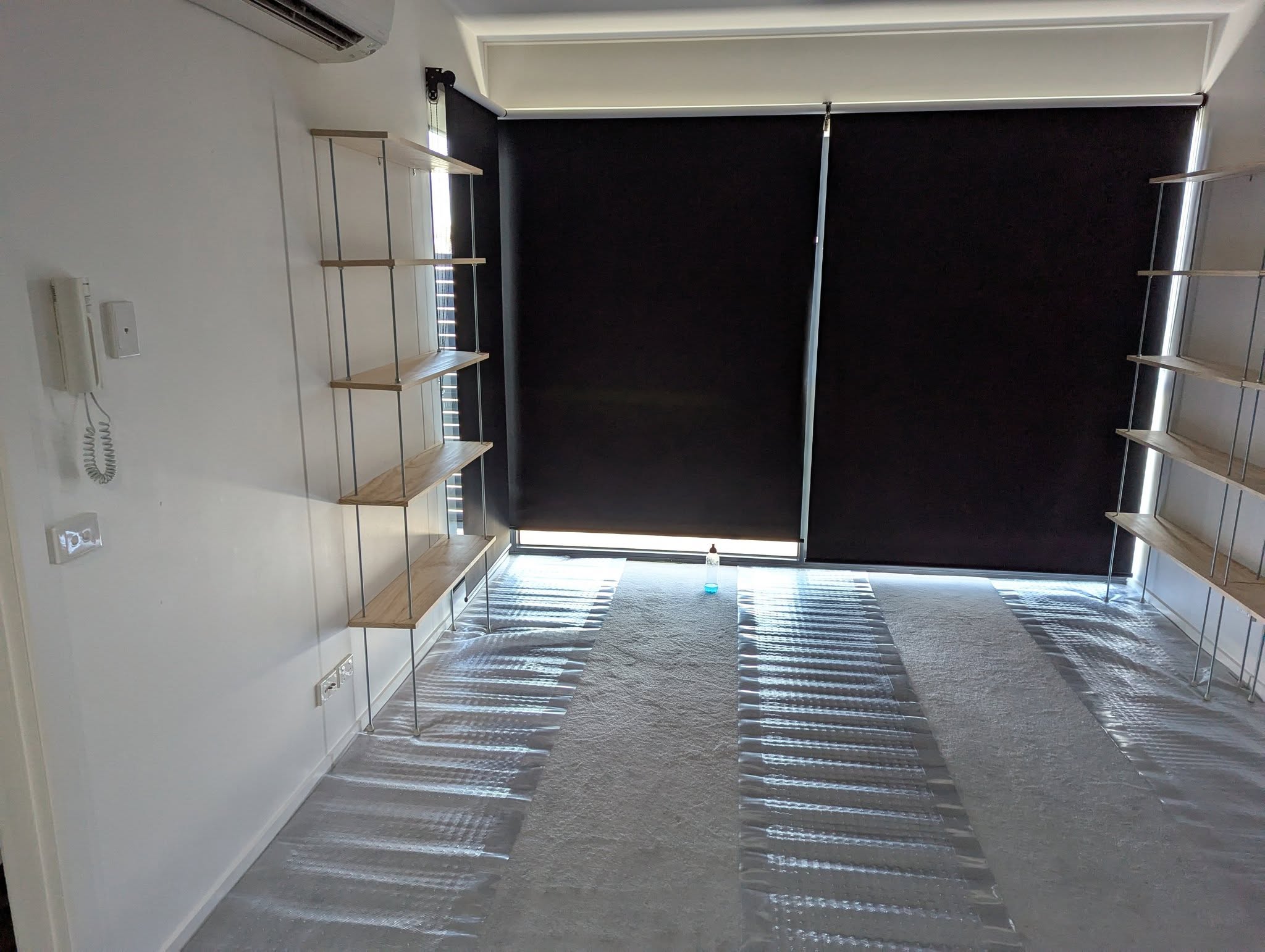
This project was an interesting demonstration of the impedance mismatch between engineering "soft"/small systems and very real, larger-scale physical ones.
When it comes to acquisition, the thinking I'm used to is "handwave to get roughly enough then add some extra". An extra capacitor can be thrown into a box with all the other spares. A two-meter threaded rod cannot. You do not buy "a few" extra spare. You get the correct number.
Similarly, my "that'll probably be enough" guesstimate for the number of nuts was not ideal.
🔗 Bill of Materials
- M10 x 1.50p x 3 meter Metric Coarse Zinc Low Tensile Allthread Rod DIN 975 - four per shelving unit
- M10 x 1.50p Coarse Zinc Class 8 Hex Standard Nuts High Tensile AS1112 - 16 per shelving unit
- M10 x 22.5mm x 2mm Galvanised Heavy Washers Low Tensile HEC Standard - 16 per shelving unit
- 4x rubber feet for rods per shelving unit - don't know SKU
- 5x drilled pine planks - don't have specs - provided by handyman
🔗 Composition
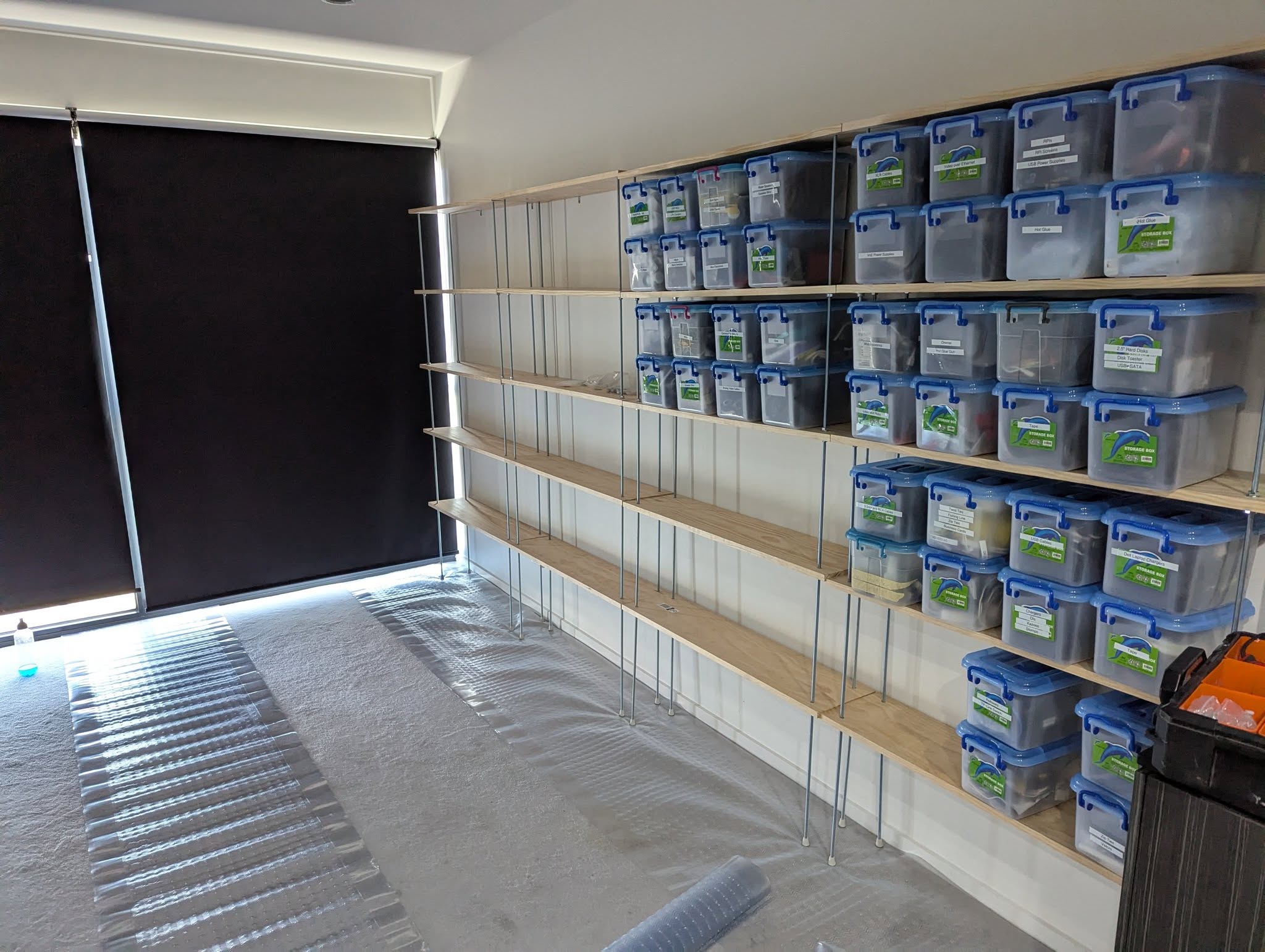
The construction we ended up using solid pine planks between the threaded rods, with the top plank being half-drilled so that the top end of the rod fits snugly into it. The top and middle planks are then anchored into the studs for stability.
The rods were cut at one end with an angle grinder to reach the appropriate height, and this chewed up the thread at that end, meaning nuts could only be inserted at the other one.
Each plank is held up by four nuts (with washers). By turning these nuts, you can move the shelving up and down continuously. It's not as convenient as grocery-store slotted shelving, and you'll need to keep a spirit level handy, but you can do arbitrarily precise adjustments and it looks much better. Aesthetically, the final product looks excellent — this is as good as "industrial chic" gets. Zero complaints.
Traditionally, the idea is to use two nuts below each plank so they kind of lock together with friction. This would have been a lot more work, and for this load one nut seems to work just fine. I was warned of possible gradual shifting over time, but it seems to be okay after almost a year. These are commonly built to be bookshelves, and I could reasonably see it mattering much more for that application.
Replacing one of the pine planks is basically impossible. You'd have to take everything off and disassemble it manually from one end by turning all of the nuts all the way to the end, then repeating the process in reverse.
The rods are alarmingly flexible without a load or anchor. Even when you've built a set of shelves, it feels comically unstable and the idea that it could store any significant weight seems ridiculous. I lost my shit when I saw how unstable one of the freestanding units was on its own — it is literally incapable of standing up on its own, and requires someone to hold it up.
However, it turns out that you only need a very small amount of anchoring to resolve this, and at that point additional weight placed on the shelves paradoxically makes them more stable. There have been zero stability issues since.
🔗 Assembly
Assembly was completed by myself and two other people. It took the three of us a little over four hours in the end, which was better than expected.
The first nut that went on was a case of... spin.. spin... spin... ...fuck. This is going to take forever. But I think four hours is actually not terrible for this, the effort scales fairly well with more people, and the challenging part was more tedium than actual passage of time. It was a good opportunity to talk shit over a mindless task.
I'm told there's a trick to do this faster with a drill, a hex socket, and a rubber band. In retrospect, I feel like it would have ended up more fiddly and not been a net win overall.
Assembling it absolutely requires more than one person — it is awkward and you will need at least one extra pair of hands.
🔗 Results
I am incredibly happy with the result. It's aesthetically perfect and the ability to adjust with fine-grained precision, while laborious, has already repeatedly come in handy. This approach definitely has major downsides, but for this use case it's pretty much perfect so far.
🔗 Could This Have Been Done Better?
Yes.
🔗 Checkin
Version: 1
Written: 2025-12-23
Written on: 7.5mg olanzapine since 2025-11-11
Mental health was: poor - estimate 25% brain