Posted: 2025-10-05
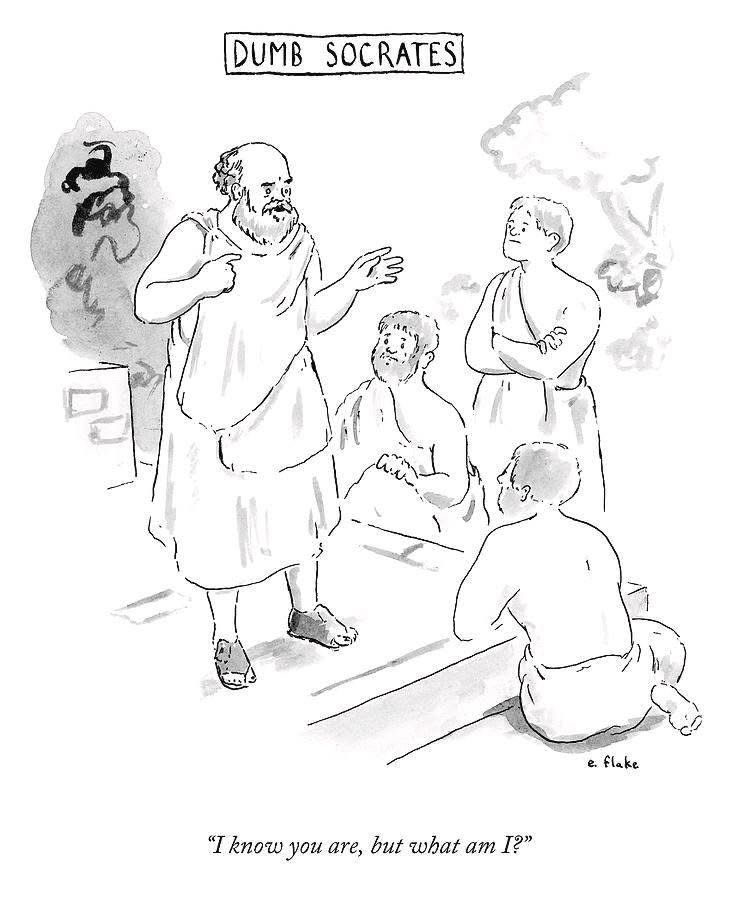
Emily Flake - Dumb Socrates (reproduced with permission)
Table-Turning 101
🔗 Introduction
Table-turning is a very common toxic communication style that many people use as a way of handling perceived criticisms or attacks. The central idea is to respond by redirecting the topic of conversation back towards the other person.
It exists on a wide continuum: sometimes it's very clear cut and simple, and other times it's difficult to clearly identify.
🔗 What It Looks Like
Person A raises a concern or problem. Person B replies with:
(Simply repeating their words back at them)
"You're one to talk."
"Same goes for you."
"That's a bit rich coming from you."
"You should take your own advice."
"What about your XYZ?"
And my favourite real-world example: "Sure, I'll stop table-turning, but you have to stop as well!"
It can consist of bringing up an unrelated past incident too.
It also often involves echoing words or phrases used in the initial concern.
🔗 Pick A Single Word
Another common version is to latch onto a single word or phrase the person used and emphasise it endlessly in an attempt to imply hypocrisy.
It often looks like: "Hmm yes, XYZ, that sure is a problem isn't it."
Or: "Interesting that you mention XYZ. Very interesting."
🔗 A Fragile Facade
Any attempt to litigate any actual hypocrisy (or lack thereof) is almost invariably met with something other than an actual argument – things like disengagement, character attacks or impressionistic “vibes”. This is because this technique is fundamentally a form of sophistry with no actual substance to it; the goal is to focus the discussion on a different person, not to actually make an argument.
🔗 Independent of Topic
A large part of what makes this a toxic communication style is that it is completely independent of the actual topic — you can make these replies to basically any concern and the structure of the interaction doesn't change at all. The response is completely disconnected from actually addressing what is being raised.
🔗 Never Defend, Only Attack
This strategy naturally evolves out of feeling like there is nothing to gain and everything to lose by defending a criticism. It therefore seeks to respond to any attack with a counterattack — placing the other person in a defensive position.
The counterattack doesn't have to make sense. It doesn't have to be based in anything and doesn't have to make any actual claims — even just a vague insinuation is fine. All it has to do is shift the focus so the other person is the one defending.
🔗 Projecting Hypocrisy
The counterattack usually takes the form of stating, implying or insinuating that the person is being hypocritical. This is likely because it takes nearly no effort — the argument has already been made — but has a high emotional return.
🔗 Narcissistic Injury
This is a very common default response style for people with narcissistic personality structures. Many narcissists do not have a full emotional model of the existence of other people, and table-turning provides a satisfying and tactically useful general-purpose response which doesn't require one. It converts scrutiny into counterattack, restores a sense of control, and avoids having to emotionally metabolise the reality that another person may have a legitimate grievance.
🔗 It Is Often A Fallback
Defense mechanisms to perceived attacks exist in layers like an onion. Some people lead with table-turning, but some people keep it deep in their stack as a late- or last-resort option.
This makes it more effective, because if they only pull out the trump card when nothing else is left, it preserves more of its power and feels more like they were trying to politely avoid pointing out the hypocrisy.
It is still equally toxic wherever it sits in the defense stack.
🔗 It's Kind Of Addictive
What's particularly problematic about this style is that it feels like you're making a good point. It feels like you undermined the person's argument, and your brain gets the reward feeling that it would have from actually picking it apart.
When they have a satisfying answer to every possible argument, and it always works, many people naturally tend towards using it more and more. It often becomes a default.
🔗 Cognitive Consequences
The upshot of regularly using table-turning is that your ability to hold yourself and others to account atrophies: if the outcome of conflict is the same regardless of what the person has actually said or done, the person's choices no longer matter. They cannot get anything right or wrong — the outcome is the same regardless.
This is absolutely devastating to a person's integrity, and their internal ethical framework can fall apart alarmingly quickly.
🔗 It Makes You A Worse Person
You owe it to yourself to catch this behaviour and to point it out in people you care about. There is effectively no upside to doing it other than feeling gratified during conflict. The long-term consequences of engaging in it are deeper and more serious than may be obvious: it structurally compromises your values and moral foundations.
Let's all do better.
🔗 Avoidant Table-Turners
Imagine the following exchange:
"Yeah, but you do those things too."
"Um, no I don't, and it's really easy to prove. I'm happy to prove it right now."
"Sigh. *disengages*"
The move didn't cash out, so they just bailed.
Someone who responds to failure of their table-turning with avoidant shutdown is really going to struggle with ethically complex situations, or even ethically simple situations involving manipulative actors.
🔗 Dealing With It
Say you are happy to address that claim after dealing with the main claim, and that we need to stay on topic for now.
Then actually follow through and genuinely explore the hypocrisy claim afterwards.
Their goal was to derail you, not to litigate, so it is very unlikely that they will genuinely be prepared to be held to their own standards.
🔗 Non-Pathological Table-Turning
Sometimes a superficially similar move is not evasive at all.
When a person with power over you imposes a standard they do not follow, applies rules asymmetrically, or makes a demand which cannot reasonably be met, pointing back at that inconsistency can be the most direct way to name the real issue.
The difference is: does bringing up hypocrisy function to avoid the substance of a concern, or to reveal the substance of the concern?
Pathological table-turning works by substituting "what about you?" for an answer.
The non-pathological form works by showing that "what about you?" is in fact part of the answer — because the rule being enforced is not a neutral rule, but a weapon, a double standard, or a demand for unilateral compliance.
In other words: if the reversal is used to escape accountability, it is deflection. If it is used to show that the accountability frame itself is corrupt, asymmetric, or fraudulent, it is exposure.
This matters most in power-imbalanced situations. A subordinate, patient, child, prisoner, employee, or abuse target may need to point to hypocrisy not to dodge the issue, but to demonstrate that the issue has been framed dishonestly from the outset.
Used carefully, this can be a legitimate and powerful move. But its purpose is different: rather than being there to derail scrutiny, it's there to identify that scrutiny is being applied selectively, manipulatively, or in bad faith.
🔗 Example
A manager disciplines an employee for being five minutes late while routinely arriving late themselves and changing expectations without notice. Pointing to that inconsistency is not changing the subject; it is evidence that the "performance concern" is being used selectively.
Checkin
Version: 3
Written: 2025-09-20, major update 2026-03-11
Written on: 10mg olanzapine since 2025-07-20; taken continuously since 2006
Cognitive capacity: very poor - estimate 10% brain